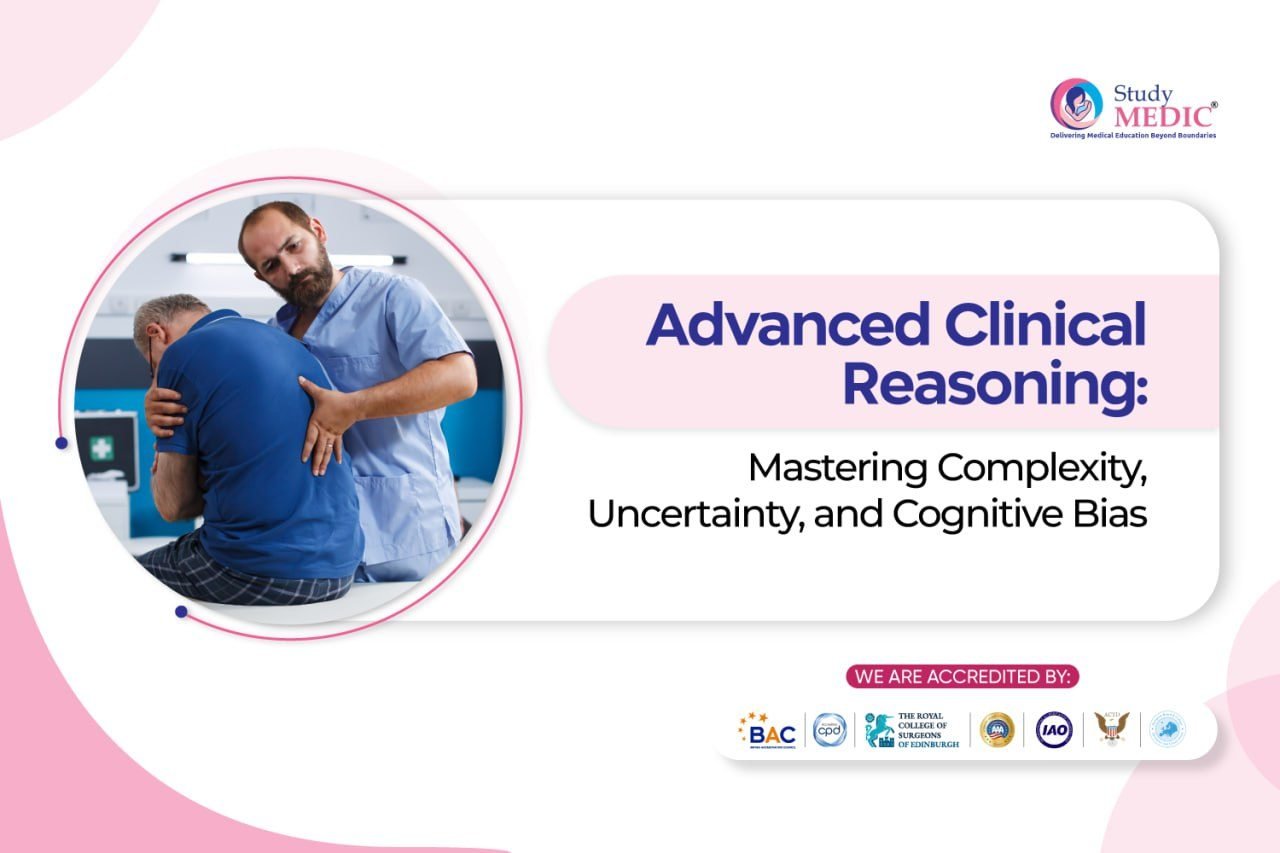
Advanced Clinical Reasoning: Mastering Complexity, Uncertainty, and Cognitive Bias
This advanced online physiotherapy CPD course is designed for experienced clinicians who recognise that not every patient fits the textbook. True expertise requires more than knowledge—it demands advanced clinical reasoning, especially in complex and uncertain scenarios.
The course introduces a structured framework to manage diagnostic uncertainty and avoid common cognitive traps. You’ll explore key biases such as anchoring and confirmation bias, learning how to shift from fast, intuitive thinking to deliberate, analytical reasoning. Through real-world case discussions, you’ll strengthen critical thinking skills essential for safe, autonomous, and patient-centred practice.
Aligned with HCPC standards and the NICE Evidence Framework, this course demonstrates how advanced reasoning supports ethical decision-making, risk management, and high-quality clinical judgement.
Course Objectives
● Differentiate well-structured and ill-structured problems and apply integrated Hypothetico-Deductive and Narrative Reasoning models to complex presentations
● Identify and mitigate common cognitive biases using practical meta-cognitive strategies
● Manage clinical uncertainty and communicate risk effectively using Shared Decision Making (SDM)
● Align advanced reasoning with HCPC standards and apply NICE guidance appropriately to avoid over-medicalisation
CPD Certification
● CPD Credit Hours: 1.5 hours
● Certificate provided on completion
Who Should Enrol
● Physiotherapists, Allied Health Professionals
● Resources Included
● Downloadable course slides and summary tools
● 30 days of access to learning materials
● CPD Certificate
Course Presenter:
Dr. Rina Pandya, PT, DPT, FHEA, PGLTHE
Dr. Rina Pandya is an internationally experienced physiotherapist with clinical and academic expertise across India, Oman, the UK, and the USA. She holds a DPT from the University of Michigan-Flint and an entry-level degree from the School of Allied Health Sciences, Manipal. A passionate advocate of evidence-based practice, she has completed a Fellowship in Higher Education (FHEA), a Postgraduate Certificate in Learning & Teaching (PGLTHE), and formal research training at the Manchester School of Physiotherapy. Her global clinical experience and practical teaching style empower clinicians to apply safe, effective, and evidence-based pain assessment and management strategies.
Features

Differentiate well-structured and ill-structured problems and apply integrated Hypothetico-Deductive and Narrative Reasoning models to complex presentations

Identify and mitigate common cognitive biases using practical meta-cognitive strategies

Align advanced reasoning with HCPC standards and apply NICE guidance appropriately to avoid over-medicalisation
Remarks
TAX is applicable for all the courses and products.Contact our Study Support team for more details
+91 8562 800 700 +44 7341 981 539 sales@studymedic.comSelect Exam Date
Related Products
-

Physiotherapy in Congestive Heart Failure: Diagnosis to Intervention
Read more Buy Now -
A Comprehensive Guide to Pregnancy related Musculoskeletal Conditions – Pregnancy Care Physiotherapy
Read more Buy Now -
Evidence-Based Antenatal Exercise Prescription: Clinical Approaches for Physiotherapists
Read more Buy Now -

Reflective Writing for Physiotherapists: From Reaction to Insight
Read more Buy Now
Reviews
There are no reviews yet.